

Stand by the Berwick Fountain on the Grand Parade on a Sunday morning and wait. Somewhere up the hill a rope gets pulled, and the bells of Shandon come rolling down over the rooftops to find you. They have been doing that since 1752. Ask anyone from the north side what the sound of Cork is and this is the answer you get.
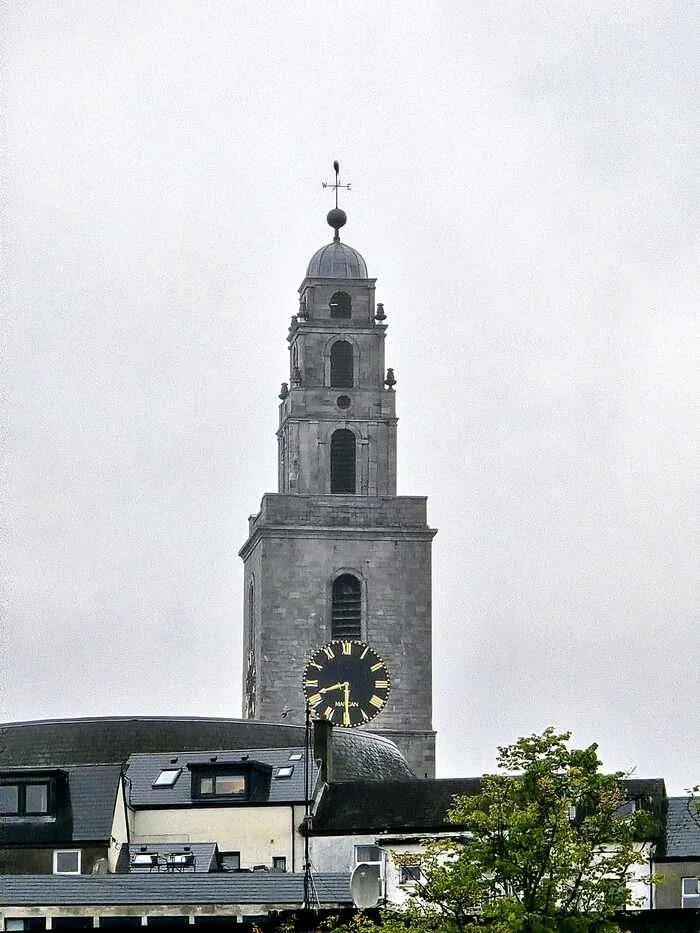
The church is St Anne's, and it sits above the river in the old Shandon quarter. You can see the tower from most of the city, which is the point of it. It stands 36 metres tall, and when you get close you notice it is built from two different stones. The north and west faces are red sandstone, salvaged from the ruins of Shandon Castle. The south and east faces are white limestone, taken from the old Franciscan friary down on the North Mall. Red and white are the Cork colours. The tower had them first, and the hurlers borrowed them later.
The four-faced liar
Look up at the clock. Now walk round the corner and look at the next one. For most of the last three hundred years the four faces have each told a slightly different time. The mechanism drives all four from a single movement, and the long hands on each face catch the wind differently, so on a breezy day one face runs a minute or two behind its neighbour. Cork people noticed, and Cork people gave the tower its name: the four-faced liar.
Nobody says it as a complaint. You will hear it from a local with a grin, the way you might describe an uncle who is always late. The clock has been repaired more than once over the years and the faces still drift apart, and most people in Shandon would be sorry if they stopped.

"With deep affection and recollection, I often think of those Shandon bells."— Francis Sylvester Mahony, "Father Prout", The Bells of Shandon (1830s). He is buried in the churchyard below the tower.
The bells themselves
Eight bells hang in the tower. Abel Rudhall cast them in Gloucester in 1750 and they were hung in 1752. The heaviest weighs more than a tonne, and every one of them is still rung by pulling a rope. You can climb up and do it yourself. At the ringing stage there is a rack of numbered cards, one for each bell, with tunes written out as sequences of numbers. You follow the numbers, and the whole of the north side hears the result.
People have been climbing Shandon to ring the bells for as long as anyone can remember. On a weekend morning you will catch a slow, slightly wandering Danny Boy or a Christmas carol in July drifting down over the roofs, and then a pause while the next visitor finds card number four. Nobody up there is a bell-ringer. That is what makes it lovely. Carry on up past the bells to the balcony at the top of the tower and the city is laid out beneath you: the river, the spires, and the hills behind.

The salmon on top
Look right to the top of the tower, above the clock, above the little cupola. That is a salmon, eleven feet long and covered in gold leaf, and it has been turning in the wind since the eighteenth century. The Lee was a salmon river and the fish is on the city's coat of arms, so when the parish wanted a weathervane, a fish was the obvious choice. Locals call it the goldie fish. When the sun catches it you can pick it out from the far side of the city, which is how many a Cork person checks the wind before deciding whether to bring a coat.

On the walk
We stop at the church and talk you through the two stones, the four clocks, the bells and the salmon. The tour does not climb the tower, so if you want to ring the bells, come back afterwards with a few euro and twenty minutes. We also walk you round the quarter itself, the butter market and the lanes, which people have lived in for longer than almost anywhere else in Cork.
Further reading
- shandonbells.ie — opening hours, and how to climb the tower and ring the bells yourself
- Wikipedia: St Anne's Church, Shandon — the building, the bells and the clock
- Cork Heritage — heritage trails and further reading on Shandon and the north side