

Cork begins here. Around the year 606 a monk called Finbarr set up a monastery on the edge of the marsh where the Lee spread out into the harbour, and a settlement grew up around it. The Irish name for the city, Corcaigh, means exactly that, a marsh. The cathedral stands on the spot where that first community prayed, and for fourteen centuries there has been a church of some kind on this ground. The one you are looking at is the youngest, and the work of one man who could not leave a single inch of it alone.
The competition
By the 1860s the plain Georgian church on the site was too small and too dull for the Church of Ireland, so in 1862 it held a competition for a replacement and told the entrants they had £15,000 to spend. A little-known London architect of thirty-five called William Burges won it with a design that was far grander, and far dearer, than the brief allowed. He talked the committee round. Then he spent the rest of his life making sure they got exactly what he had drawn, and the final bill came to several times the original figure. Nobody in Cork has ever asked for the money back.
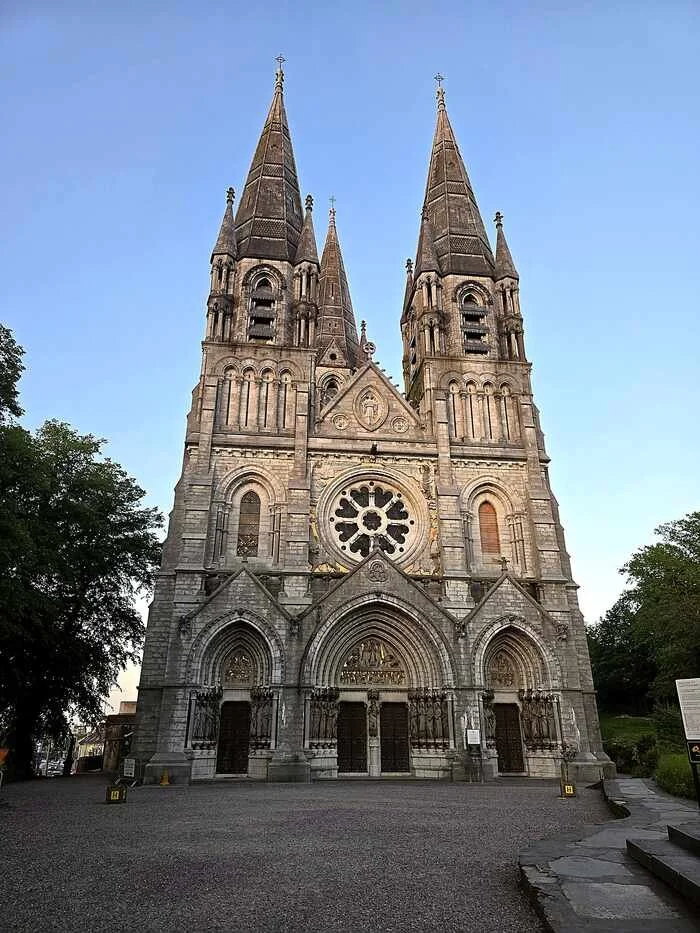
Burges's masterpiece
Work ran from 1865 to 1879 in pale Cork limestone, in the French Gothic style Burges loved above everything. Three spires rise over the river, the tallest close to 240 feet, and you can see them from most of the city. Inside and out he packed in more than a thousand pieces of sculpture, angels, prophets, beasts and whole Bible stories in stone, marble and mosaic, and he designed the lot himself, down to the pulpit, the bishop's throne, the floor tiles and the door handles. Few cathedrals of its size carry so much detail. Almost none carry the stamp of a single mind so completely.

"When the angel sounds its trumpets, Cork will get the warning first."— Cork tradition, of the golden Resurrection Angel
The golden angel and the cannonball
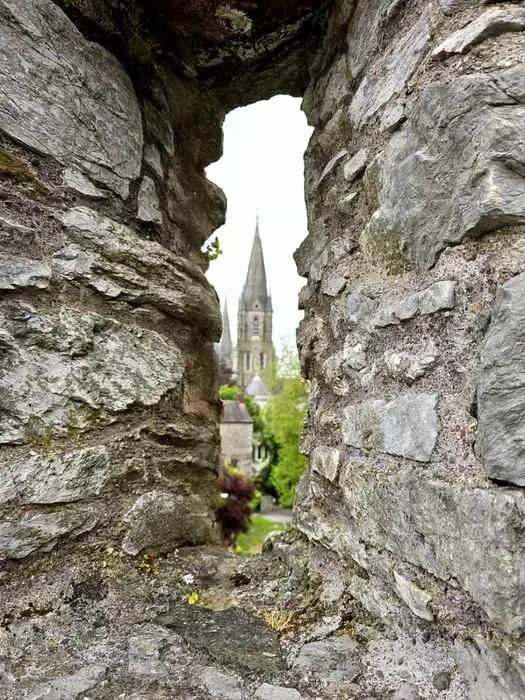
High on the eastern end stands the Resurrection Angel, sheathed in gold leaf and catching whatever light Cork has to offer. Burges put it there himself. Local belief holds that when the end of the world comes the angel will blow its two trumpets, and that Cork, naturally, will get the news before anyone else. Look for it from the road below the east end, or from the top of Elizabeth Fort across the road, where the whole cathedral lines up in one view.
Inside, near the entrance, hangs a cannonball. It was fired during the Siege of Cork in 1690, most likely from Elizabeth Fort, and lodged in the tower of the older church, where the builders found it still buried in the stone when they pulled the old building down in the 1860s. It is a blunt reminder that this calm, extravagant building sits in a city that has been fought over for a very long time.

On the walk
We start where Cork started. The cathedral marks the founding of the city and sets the scene for everything that follows on the walk, from the marsh and the monastery to the merchants, the rebels and the river. Look up for the angel before we move on.
Further reading
- Saint Fin Barre's Cathedral — the cathedral's own history and visitor information
- Wikipedia: Saint Fin Barre's Cathedral — its building and architecture
- Wikipedia: William Burges — the architect who gave his life to it